|
| Typecast from my 1964 Hermes 3000 |
 |
| Old issue is on the left. The next oldest, center. The new on the right. Inside they are all alike. 96 sheets of college ruled white sulphite paper. Pages are not pre-numbered. Binding is sewn and almost lay-flat. These are often referred to as the Green Books. |
 |
| This is the back cover. Covers are hard and the binding is smith-sewn, but the structure of the spline does not allow completely flat opening. The binding can be forced without damage and then the notebooks do lay nearly flat. I found Piccadilly lay the flattest. I get to those later. |
 |
| I found the mil-spec on these and it does not list paper weight or if it is acid free. I have some of these that are probably 40 years old, and not stored in a climate controlled environment, and none yellowed. I measured a sheet of paper. It is .0041 inches thick. I think this is about the same as 50 pound? I lost my notes on weight vs. thickness. |
 |
| Here's a Moleskine. .0037 inch thick. 0.0003 thinner, for whatever it is worth. I know it bleeds through more or about the same depending on the pen as the green books. |
 |
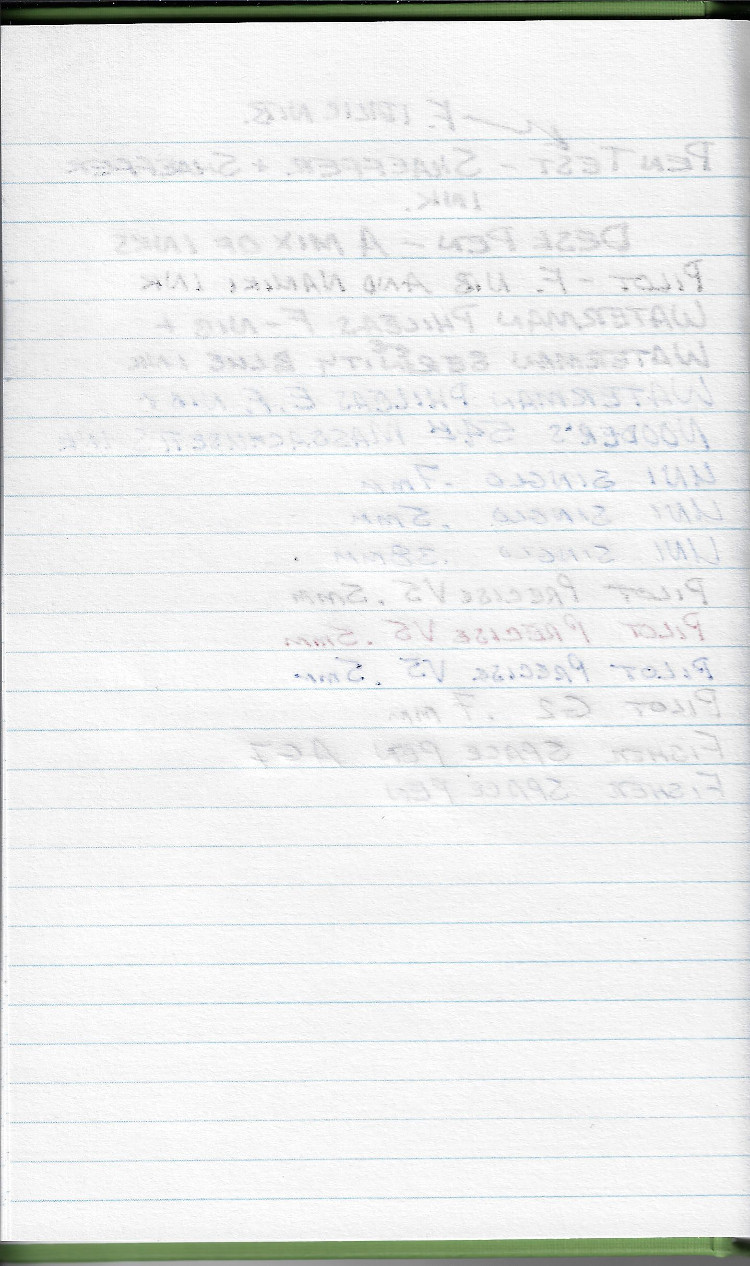
| I tested the ink with the pens I have inked. There is a smudge on the L in Pilot, but I have had this pen smudge or blot on almost every paper I used. Feathering is quite limited until I use a wet nib such as seen with my desk pen. I like the Noodler's. It is the ink I generally use. Bullet proof and I like the color. Uni inks are also temper resistant. |
The covers of these books measure 5.125 inches by 8 inches and the pages 4.750 inches x 7.750 inches.
These notebooks are often described as having a cloth cover. I do not know how old the ones are with cloth covers. I got my first on in 1972 from the Army. I don't remember the cover being different than the oldest one I have. I don't remember where I got that one. It may have been from the government or I may have gotten it when I worked in the Army Surplus store where we'd have gotten them on government auction. All of the covers are nice and seem like cloth. If it is, it is very very thin cloth. The oldest is the nicest. It may be cloth. They all seem more like embossed paper though.
I like that the covers are not too brightly or darkly colored, and I can write on them with a Sharpie or other felt tipped marker.
I'll be reviewing some Chinese and one from Taiwan that are cloth covered hard bound A5 notebooks.
The white sulphite paper is nothing different from 3 ring binder notebook paper or the paper found in many spiral bound notebooks and the black and white cardboard cover Composition Books. I have some of those Composition Books since high school (Hey! I'm an old guy. It won't be long I'll be out 50 years) that were stored in attics and basements, and the paper has never yet deteriorated. I guessing the paper is acid free since I have many other books and notebooks that have yellowed under those same conditions.
I have not had problems using a fountain pen with these notebooks. If the nib is too wet there is shadowing through to the back, but I seldom write on the back. I may use the pocket Moleskine I have and compare the two. I'd rather a plain page or a lined page though. Quad paper makes bleed though a bit harder to see.
For the ink feathering and bleed through I do not change scanner settings or edit the image files. Setting manipulation and file editing can make the ink look better and the bleed through lighter or even darker.
Overall these notebooks are very nice for what they cost, and the are nearly indestructible. I've not had any where the binding loosens or the pages fall out or come loose. I use these at home, in the garage, and out in the outdoors.
Stay home, get out in the yard for some fresh air (or open the windows if the outside temperature is ok, and stay safe.