Sunday, November 9, 2014

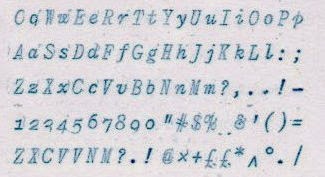
Hammond Multiplex Shuttles Typing Samples


10 C.P.I.

10 C.P.I.

170, 10 C.P.I.

10 C.P.I.

This may also be 170, 10 C.P.I.

10 C.P.I.

10 C.P.I.

170

10 C.P.I.

10 C.P.I.

10 C.P.I.

170

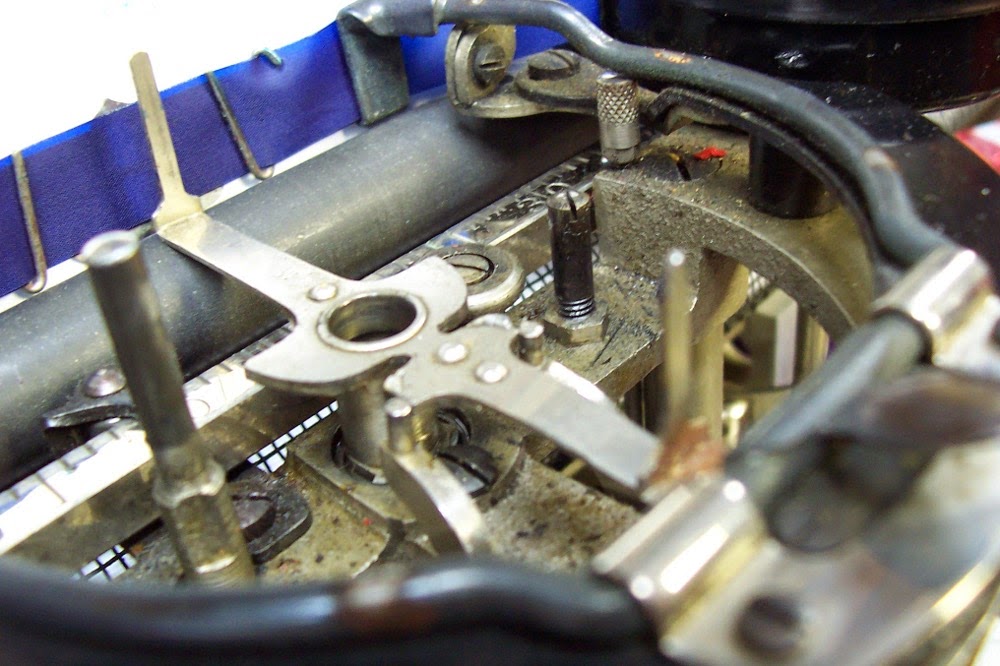
Shuttle positioner

shuttle positioner showing all the dirt I need to remove.

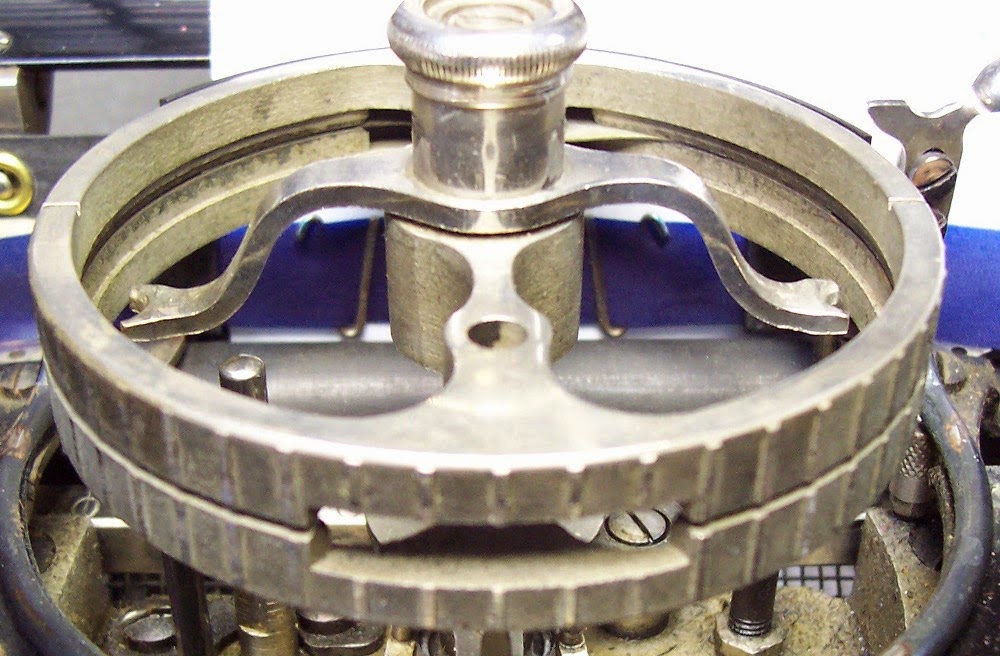
Shuttle holder in loading position. It sits on the two pins shown on the positioner.

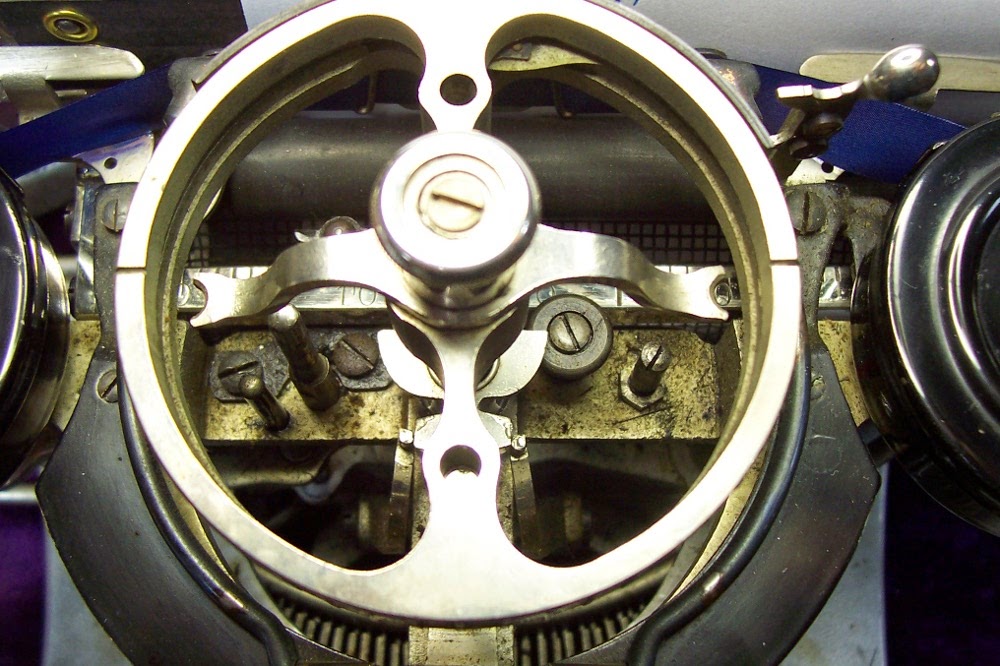
Top view

Shuttles loaded

Shuttles in position

Everything is in its home positon and ready to type.  Shuttle to be used is at the top of the photo and the one that can be moved into position by lifiting up on the knob and turning the whole assembly 180 degrees is in the bottom of the photo.
Testing the shuttles turned out to be quite a challenge.  Most do not have numbers on them to verify the typeface.  All are 10 c.p.i. even though the characters differ in size.  Several of the shuttles did not get tested as they do not freely slide around the holder.  By hand I cannot feel any sticking, but the mechanism will jam when they are used. Several others are duplicate typefaces.

This took most of the day.  I tried to get the shuttles that would not slide easily to slide.  This was taking too long so they are tagged and repairs may happen later.
In doing the work I forgot to scale each sample with a one inch line and mark the name and number of the shuttle if I could cross reference it to my previous post.

Now if I can only complete the final challenge; finding the date of manufacture.  It may be 1915, 1916, or maybe even 1918.  The serial number and cast machined aluminum frame and the Typewriter Database places it in 1915 as a Multiplex portable with a different case.  This one is portable and has the square case like the folding model (not the neat curved case as the older models). On line I have not found a Hammond Multiplex verses a Hammond Multiplex portable.  They all look the same size.  I've a tremendous amout of learning to do with the history of these machines if I choose to dig into it.

This is a fun typewriter to use once I mastered the unique touch.  Not a hard touch, a unique one.  Not very fast though.  If I were to compare the speed of this one to a modern one I would say it is about as fast as my SM3, SM7 & SM9 Olympia typewriters.  However the touch may be more like my Remington Noiseless Model 7.

Now to get a purple ribbon for it.  I may never use the black one I ordered.

Friday, November 7, 2014

Maiden Typecast From A Hammond Multiplex


Repairs finished and test sheet.

Corrections with a carpenter's pencil I pointed since I typed this at my workbench.  I also did not correct all typos.  Hammond typed nearly to the very bottom of the sheet.


I mounted it back on the lid, but this is a photo I've used before.
I like using this typewriter, but I may not use it as often as I'd like.  The shuttles are hard rubber or Vulcanite (Thanks Richard) and I do not want to damage them.  Most need cleaning.  I'm unsure if I want to only brush them or use a mild cleaner.

One thing I noticed while typing is the shuttles must be extremely free.  The one with the larger typeface is the best so far.  It slides very freely.  I think the italic one will too once I treat it with Teflon Lube. 

The touch is quite unique on this machine.  I find I cannot hit the keys or I get the blurred letters. If I press too hard I get blurred letters.  I found a nice steady and intentional rhythm works best, like musical slow 6/8.  As stiff as the carriage return is on this I have a tendency to want to press hard as if to over come hard key touch.  The way the hammer works hard pressing is not required. 

The back space is quite easy and had its own uniqueness.  My biggest problem besides wanting to hit the keys is using the triple shift.  I found it easier to adapt to my Corona 3 than the Hammond.  Margin release key is completly smooth.  On all my other typewriters the end of line lock will lock the keys and pressing the M-R key causes a click and slight motion and sometimes a hard click and bump of the carriage.  Not so with this one. Press, releases the lock, and absolutely no motions or clicks.

The index for the placement of a letter on the page is nicer than looking at the typebar slot on newer machines too.  Hammond has a pointer at the spot for a letter or symbol.  There is also an index scale, but it is not as visible as on newer machines.

I hope to test all the shuttles soon.  If I do I hope there is room on the Typewriter Database for all of them.  They'll be posted here whether or not they fit on Ted's site.

One reason I gave up my Olivetti Praxis 48 was I found an IBM Selectric-II.  I always liked the interchangeable elements.  Until I started this hobby (obsession) I never knew of the Hammond -- it had interchangeable elements a Century before IBM!  (ok, I exaggerated a bit)

Now to search for additional shuttles.

Sunday, November 2, 2014

Hammond Multiplex Left Side Keys Z-Only Problem Solved


 I was hoping the ribbon would be good enough to typecast from the Hammond, but it is too light.  I need to respool one onto the Hammond hubs.  I hope I can buy a long bulk ribbon from Baco.

From The Classic Typewriter Page:
Baco Ribbons makes ribbons in many sizes, colors, and materials. Contact Charlene Oesch, Baco Ribbon & Supply Co., 1521 Carman Road, Ballwin, MO 63021, 314-835-9300, fax 636-394-5475, e-mail bacoribbon@sbcglobal.net.

Impression strip on my Wal-Mart lazy susan.                                                                                                                           Gee from Type OH! The manual typewriter experience first showed one of these on his Hammond Multiplex.  I had bee too tight to buy one, but after several attempts at trying to find a bicycle rim liner I broke down and visited the Ebay seller and bought one.  Very well worth the price.
blogger does not display the caption on the blog like it appears in the editor!
This is the impression strip installed.

Not a very good image splice.   I hope you ' get the picture'
Z rod sticking in UP. The lever that rotates to move the shuttle stops at whichever key presses its rod up.

Notice the ferrule on the Z stays down.

Normal operation.  The spring goes up with the rod to provide return tension. Third one to the right is Z.  It will eventually drift into the up position even if the key is not pressed.  Looks like #4 is drifing up, but it is fine.


This looks like a 35mm printed with the negative installed with the emulsion side up in the negative carrier.  I did not notice it in GIMP.  I flipped the photo because I took the photo the only way I could get close with the camera.  That showed this upside-down. The image looks like the right side of the assembly.  It is really the left.  Z is the third rod from the left end of the assembly.

A better macro of the previous image.  Sorry for the reversal.

My chime clock after being replaced on the shelf in the living room with the Hammond, and after it was cleaned with Murphy's Oil Soap.
Type OH! The manual typewriter experience

raphaelcarl 
is the Ebay seller of the Hammond Impression Strip

 I hope the Ebayer does not mind a referral from my blog.

The clock is one of those projects where I should have done some before and after photos as it was quite dull and dirty looking before I decided to clean it and get it running for the first time since moving to Florida.  It sat on our book case as a decoration as I did not want to start the chimes.  This is a reproduction of a real chime clock. It does not have a silence key to silence the chimes.  Once the chime spring winds down it will not chime.  I've not decided to keep it or offer it to a Typospherian who likes clocks.