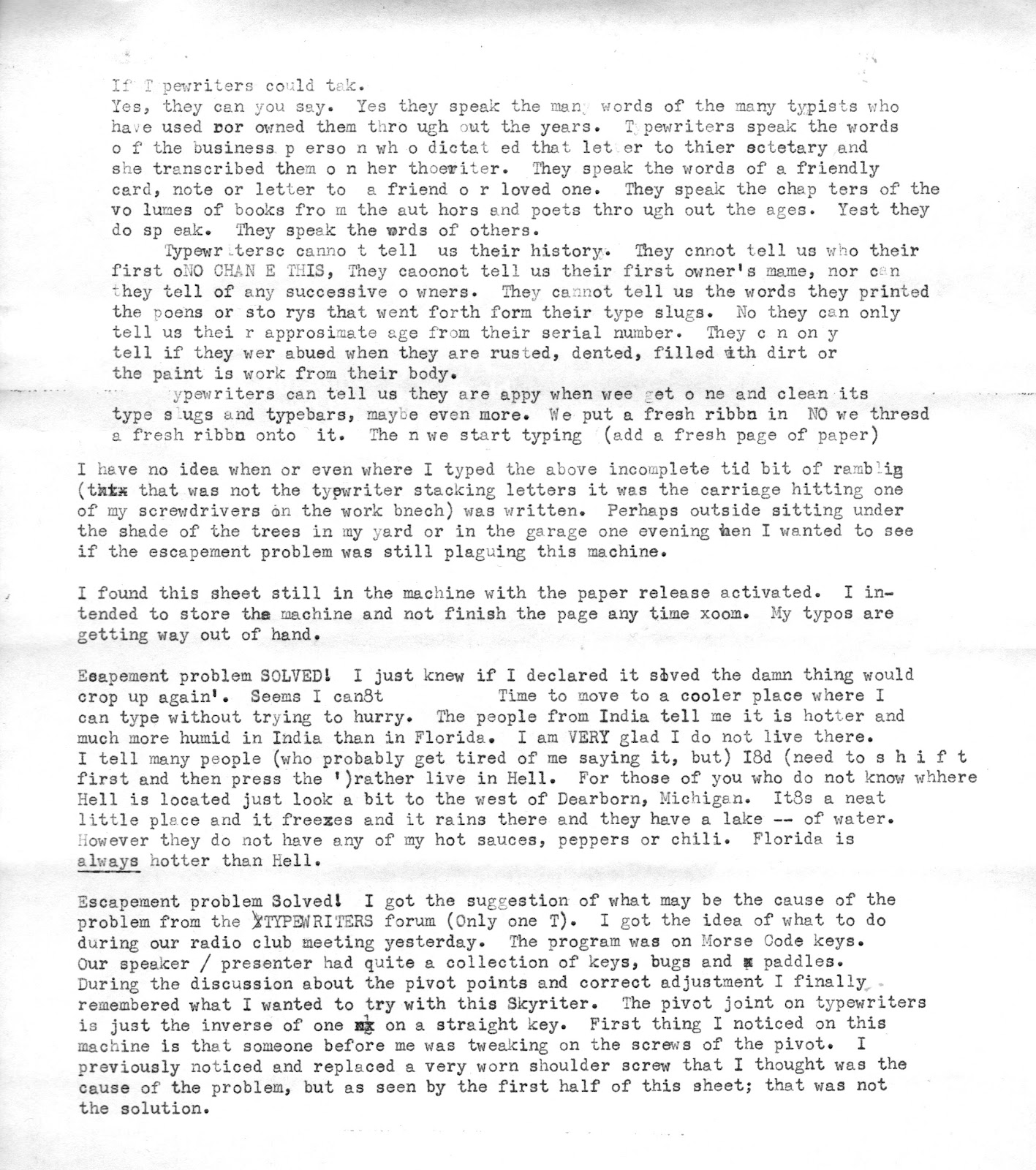
As you can see my problem is not completely solved. I think a complete dis-assembly and a good polishing of all the parts of the pivot assembly may help. I'm open to suggestions.
 |
| The pivot joint and adjusting screws. The right one after I adjusted it and the left as both were found. |
This is the lever that moves up and down into the escapement ratchet gear to hold the carriage as it moves only one space.
 |
| This is the pivot joint engaged to hold the platen after one letter is typed. |
What I found is that this would stick engaged to the tooth or it would be in the middle of 2 teeth when the machine would skip or not feed to the next space.
 |
| First repair was to replace the original screw. This screw has 2 shoulders. One fit into the slide and the bigger one held out with a small washer. Without the washer there is too much slop in this joint. |
 |
| More of the machine. I stopped typing to take this one. |
 |
| My Bunnell Spark Gap key. |
 |
| My Vibroplex Brass Racer Iambic Paddles. |
Bugs
Even more
Bugs
If you'd like to see more keys Google Morse Code Key and look at the images.
Many ham radio operators collect keys. At one time code use is what separated hams from the other radio folks. That is not so true any longer as the code is not required for a license. One can have a lot of fun and never use the code. I discovered that I can use the code and have even more fun.
I was one that did not like the code when it was required to go to the F.C.C. field office and prove you could send and receive the code. I forget the requirement for the Novice class I think that was either 2 or 5 words per minute and was administered by a local ham operator with a General or higher class license.
To get a General required 13 words per minute. I do not remember what the Advanced class required. Extra required 20 or 25 words per minute.
I looked at it as a way to keep people out of the hobby. After I got my Technician class I decided to at least get a General class license. Anyone can learn 5 words per minute! I found that to be true with all of the modern computer code programs available.
To make a short story and not bore you; After I got my General and got on the air I soon found CW or the Morse Code to be much more enjoyable than the phone bands. I was soon building QRP (low power) transmitters and doing mostly code no matter what power I used.
I encourage anyone interested in building or using radios to get their license and get on the air, learn the code and have fun. Amateur radio encompasses much more than merely radio and the code. There really is something for everyone. One day I may make a USB typewriter to send code. Then there is always RTTY (radio telegraph) Many use a keyboard now, but the many teletype people still have the old typewriter keyboard teletype machines.
73 de Bill