|
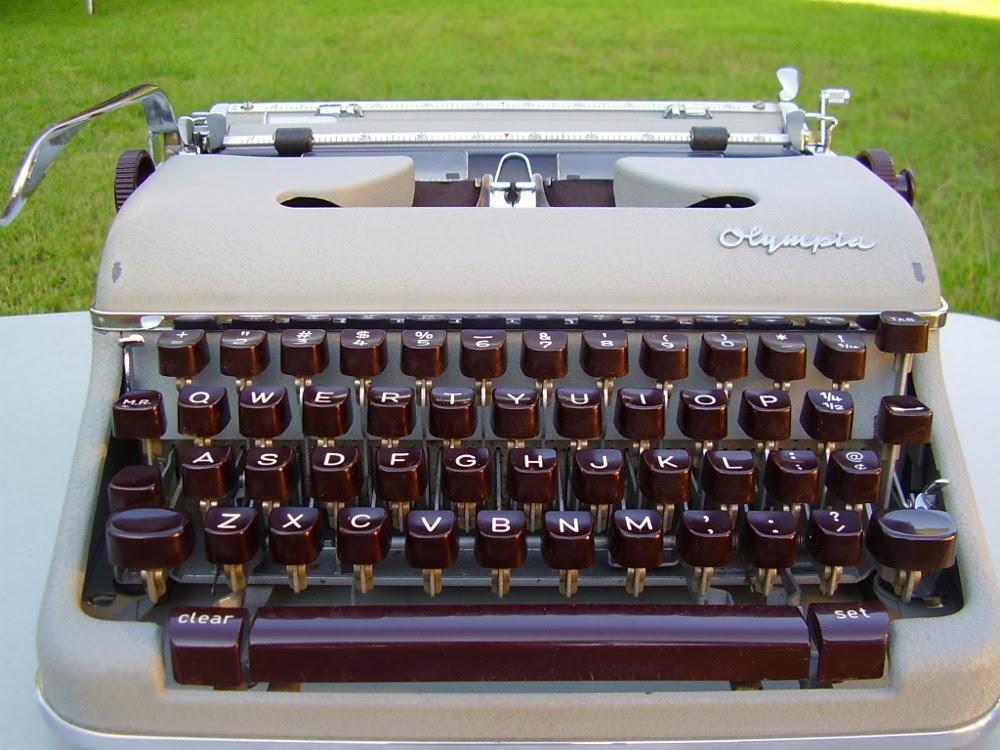
| I could not find the model name for this one. It looks like several. Closest I can find is the Rhythm Touch. |
 |
| I guess you can tell I get 2 sections of a typecast from one sheet. |
 |
| I like the shift lock key on both sides. The margin set on these is different than the ones on the rear. Left sets the right margin and right sets the left margin. The setting is made by squeezing the indicator and sliding it into position. |
 |
| Left Side. Pressure rollers are still soft. Platen is hard. Feeds paper like a champ. Straight and even from the start all through to the end. |
 |
| Right Side. |
 |
| I just noticed I typed one CR on the right and the one on the right. It should be the one on the left is a carriage return and line feed while the one on the right is just a hook that can move the carriage. |
 |
| Left end |
 |
| Right end. Is this a right hand carriage return or is it used in conjunction with the carriage release to guide the carriage to position? What is the purpose of the chrome piece under it? The tab beside the hook, when pressed, allows the left margin stop to be over-ridden. |
 |
| The typewriter was quite dusty, but the bottom is near spotless. |
 |
| Carriage return / line feed |
 |
| Card guides in position |
 |
| Card Guides retracted |
 |
| I thought this was unique. Nearly hidden is the ribbon guide where the ribbon comes off the spool. There is a little lever on the spool holder that moves the guide out. It is spring return. Sorry, I mis-spelled guide. |
 |
| Halda - Facit, Underwood had a round smooth easy (easier than my TP-1 actually) to slide carriage rail too. |
 |
| The only thing on the back (sorry I did not take a photo) is Underwood Standard across the top and in the middle Product of Underwood Corporation. I've always liked the scale and margin sets right on the front of the carriage. |
 |
| The only thing I find referencing 11 is in 1927. This machine is newer than 1927. | |
I believe this is a Rhythm Touch, but I am not sure. It matches the Underwood Standard from 1947 on
Alan Seaver's site. Mine is not as clean, yet. The numbers past the 11 (which may indicate the platen or carriage length) put this machine in 1947.
The book I mentioned I found by a link Robert Messenger posted on
his blog, but I could not find it again to link to his post. The book was written in 1917,
The Evolution of the Typewriter.
So far the best 2 typers in my collection are my Underwood Standard Portable 4 Bank and this typewriter. Nothing is as fast and easy to key as these two. My Adler J4 comes close, but just does not quite make the fantastic Underwood feel.