Monday, May 21, 2012

Here's the Answer to Taking Apart A Hermes 3000 Part 1 and the Hermes 3000 Taken Apart

The depressing typewriter, no back space, tabulator, left platen knob, right margin, bell, 1 or 0.  A 1932-33 Royal Signet.

I read on several sites about this being a depressing typewriter from the Great Depression.  I think it is quite neat.  I like the all upper case oblique or italic pica font.  I do get confused and hit the Z for a shift key at times though.  It's big brother is on my wish list.

Thank you Dwayne F. and Richard P.  you were the only readers who attempted to name the typewirter.  Dwayne answered correctly on the first post.

This is the typewriter I like to keep at work.  I may take my Underwood.  Then every other month I would have a different machine.

Plans are not to be too long to post on putting the Hermes 3000 back together.  I may do it before I do the Noiseless 7s.

Sunday, May 20, 2012

This is the Rounded Body Hermes 3000 Taken Apart

Sorry for my blasted typos.

This is the second Hermes 3000 I bought last year.  I wanted a rounded one.

Why do these older style knobs stay in one piece and the newer one fall apart? The odd shaped plates to the left of the feet hold the typewriter to the housing and the bottom plate.

Almost naked.  I guess it would be should I remove the key tops.

Carriage.  The covers will be removed when it all gets cleaned.

Left-most part of the angle was bent.  Apparently this machine was dropped on its left rear corner.  Cheap aluminum sides for an otherwise very high quality machine.

close-up of the worst damaged end.

Carriage fastener in the remove position.

When both are in this position the carriage is fastened to the machine.  Small screw moves carriage closer to or farther away from the front of the machine?

There was some slight bending to this sides ends also.

Where the damage had been.  Now straight.  There is some distortion to the slot that does not affect anything.

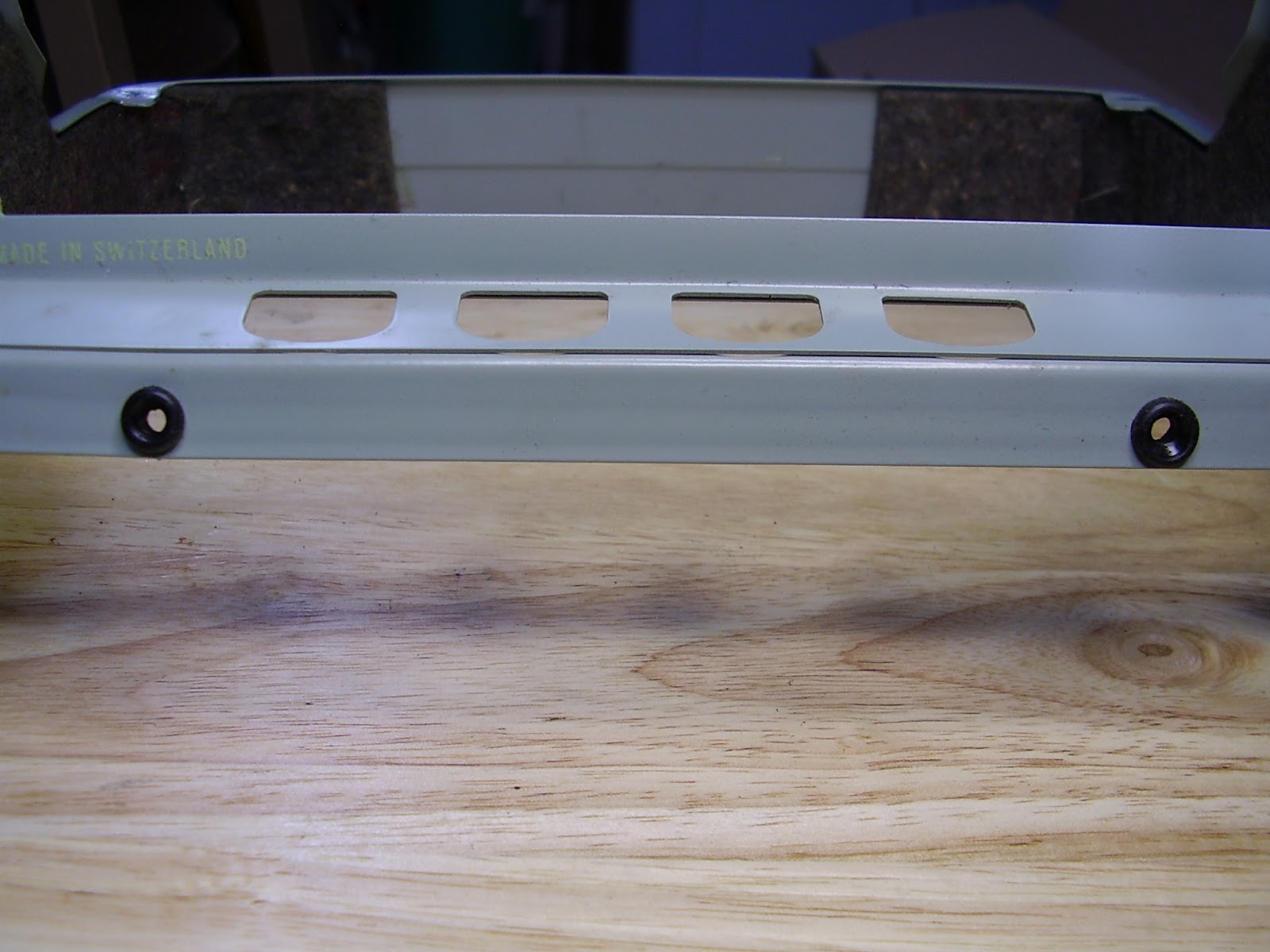
To remove the housing the tow screws that go in these holes must be removed.

It even has genuine Hermes ribbon spools.  Ribbon is dry.
So from seeing the typecast done on a full sheet again may give another hint as to the typewriter used.  I'm surprised at only one guess from yesterday's post.
I'm giving a few more days to see if there are any other readers who want to post a guess at what this machine without a 1 or a 0 key just might be.  Then as many of the old portables; no tabulator either.  It came home with me because I liked its typeface, and it had a good ribbon too.

This project could or would not be done if it were not for this post I found when I got my first Hermes 3000:

Replacing a Hermes 3000 Platen

And a big thank you to Tom Furrier of Cambridge Typewriter Co. for his very detailed and easy to follow post as well as the help he gave through some emails when I had some problems with my first Hermes 3000.  This got me started in tinkering with my machines.

I also thank Richard Polt for his help and fine website.  Richard has always taken time to answer my emails on typewriter questions.

Well there are many others in the typosphere also.  I get my ideas and confidence to take on my projects from all of you.  Thank you.

Saturday, May 19, 2012

A Hermes 3000 Taken Apart Part 1 and a Quiz


After scanning and posting I noticed a few more typos than I thought I made.
I also got the paper in my scanner a bit slanted.
This typecast is a bit different than most.  I do not have any photos at this time.

I took the machine apart at work and typed the above at work and finished it under a shade tree sitting at a pick-nick table behind one of the gasoline stations on the way home from work.

Normally this is a nice quite place where I can read, write or relax.  Not so with a typewriter.  I caused a bit of interest from the owner and some of the customers when they saw some fellow sitting under the tree typing.

This particular machine caused quite a bit of interest also.

Which one did I use?  I won't tell you.  Take a guess.